




- Typical Lifespan: Rigid panels often achieve 50,000 to 100,000 hours of rated lifespan (L70 – when brightness drops to 70%). Quality flexible panels usually target 50,000 hours as well.
- Primary Weakness: The flexible panels’ protective encapsulation (like silicone resin) is less durable than rigid panels’ robust aluminum alloy housing. This encapsulation can degrade faster due to environmental factors and physical stress.
- Environmental Impact: Both types are affected by extreme environments. Rigid panels excel in high humidity or dusty areas thanks to their sealed metal enclosures. Flexible panels are more vulnerable to UV degradation and tears/scratches, especially outdoors or in high-traffic setups.
What Are Rigid and Flexible LED Panels?
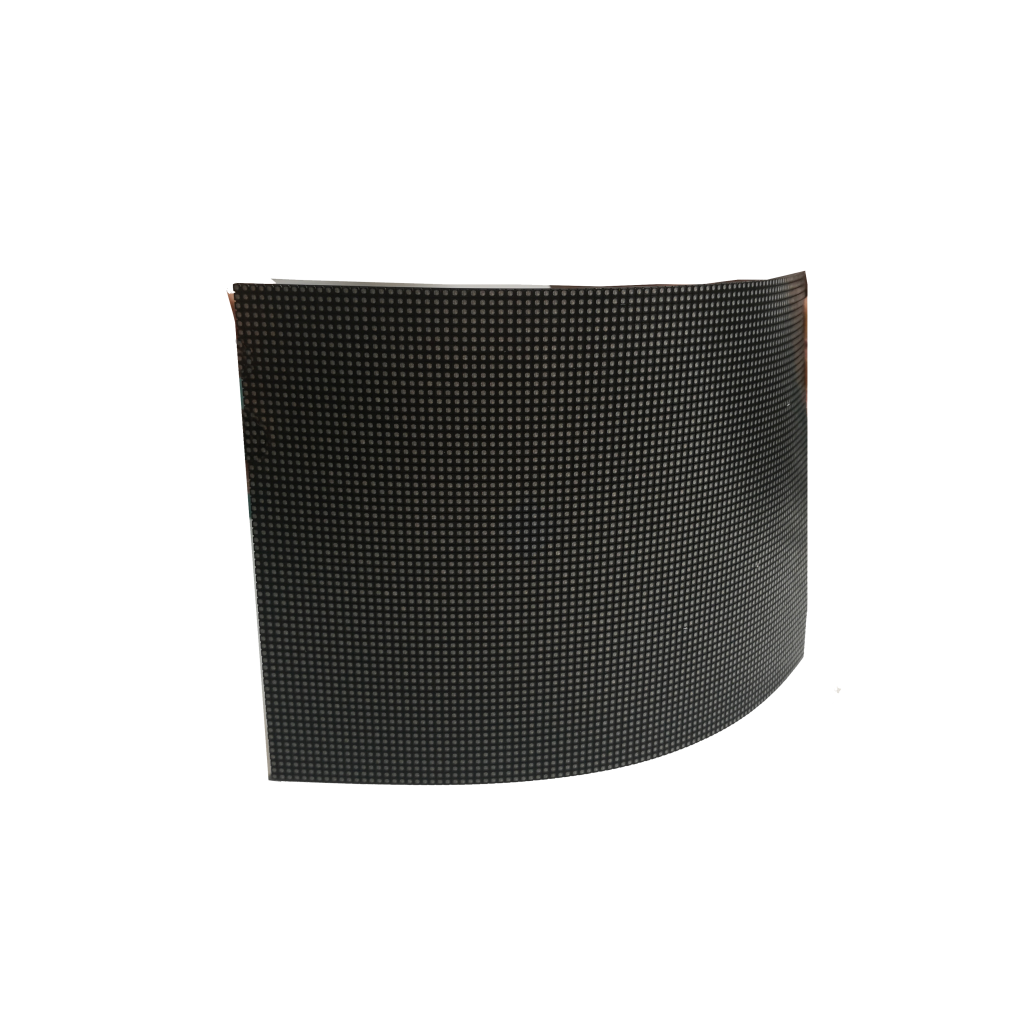
Rigid LED panels use aluminum alloy housings (typically 1.5mm–3mm thick) that provide structural integrity, while flexible panels rely on silicone resin encapsulation (0.5mm–1.2mm thick) bonded to flexible PCB substrates. The core difference lies in rigidity versus bendability: rigid panels maintain a fixed, flat shape with pixel pitches ranging from P0.9 to P10mm, whereas flexible panels can bend to radiuses of 2–5cm with pitches usually between P1.2 to P6mm. Power consumption averages 500–800W/m² for both types, but rigid versions often achieve slightly higher brightness (6,000–10,000 nits) compared to flexible ones (4,500–8,000 nits) due to superior heat dissipation. Environmental resilience also diverges significantly—rigid panels typically carry IP65/IP67 ratings allowing operation in ‑20°C to 60°C temperatures and 85% humidity, while flexible panels average IP54 and tolerate ‑10°C to 50°C, reflecting their trade-offs in durability.
Materials and Construction
Rigid panels feature die-cast aluminum frames paired with polycarbonate or tempered glass faces (3–5mm thickness), creating a sealed, robust structure weighing 18–25kg/m². Their LEDs are mounted on rigid FR4 PCBs (1.6–2.0mm thick) with copper layers conducting 5–15A per module, enabling sustained high brightness. Flexible panels, conversely, use PET or PI films (0.1–0.3mm thick) laminated over ultrathin FPCBs (0.2–0.8mm thickness), reducing weight to 5–12kg/m² yet increasing vulnerability to physical damage. The silicone encapsulation degrades under continuous UV exposure, with yellowing observed after 12–24 months outdoors, whereas rigid housings retain clarity for 5–7 years. Component density differs too: rigid PCBs support 10,000–50,000 LEDs/m² at fine pitches like P1.2mm, while flexible versions max out at 25,000 LEDs/m² due to material constraints.
Technical Performance Parameters
Peak brightness decay illustrates key differences: rigid panels maintain 70% output (L70 rating) for 80,000–100,000 hours due to 10–20°C lower operating temperatures from aluminum heatsinks. Flexible panels average 50,000–70,000 hours to L70, with bending cycles accelerating decay—each ±90° flex reduces lifespan by ~0.01% per cycle. Power efficiency favors rigids at 1.5–2.2 µmol/J (micromoles per joule) in photon efficacy versus 1.2–1.8 µmol/J for flexibles, as airflow cools their drivers more effectively. Color consistency also varies: rigid panels sustain ±0.003 Delta E deviation over 8,000 hours, while flexibles drift to ±0.005 Delta E at half that duration. Voltage requirements diverge too—rigids typically use 110–240V AC, whereas flexibles run on 5–48V DC to minimize resistive losses in thin conductors.
Environmental and Usage Limits
For extreme environments, rigid panels support ≥85% humidity and ‑40°C cold starts with <2% brightness drop, whereas flexibles risk delamination above 60% humidity and exhibit 5–8% dimming below 0°C. Shock resistance tests show rigids enduring 20–50G impacts (per MIL-STD-810G) without failure, while flexibles tolerate only 5–15G before connector or LED damage occurs. In 55°C ambient heat, rigids maintain ≤80°C LED junction temperatures with 5–8°C/W thermal resistance, but flexibles reach ≥95°C (thermal resistance 10–15°C/W), escalating failure rates by 1.5x. Bending specifications further limit flexible panels: curvature exceeding 15–20° per meter causes hotspot temperatures to spike 10–20°C, and repeated 90° folds (>10,000 cycles) create microcracks in 10–15% of units. Rigids impose spatial constraints instead—they require ≥50cm mounting depth and fixed 16:9 or 4:3 aspect ratios, whereas flexibles install in <10cm depths and curve around 20–30m radii for cylindrical displays.
Key Things That Affect LED Panel Lifespan
The operational lifespan of LED panels—whether rigid or flexible—isn’t fixed; it swings dramatically based on environmental conditions, usage patterns, and build quality. Data reveals a 48%–63% spread in longevity for panels sharing identical specifications: a premium rigid unit in a climate-controlled lobby lasts ≈95,000 hours to L70 brightness, while its counterpart in an outdoor billboard averages ≤55,000 hours due to UV and thermal stress. Humidity above 85% RH can accelerate corrosion by 15–22%, and each 10°C increase in ambient temperature beyond 25°C truncates lifespan by ≈30% per Arrhenius modeling. Electrical factors matter too—panels driven at >90% peak brightness decay 2.5× faster than those at 50%, while unstable voltage (±15% fluctuation) causes early driver failures in 17–24% of units within 3 years.
Environmental Stressors
LEDs sustain permanent damage when junction temperatures exceed 140°C, causing phosphor degradation rates to surge by ≥0.8% per hour. Rigid panels manage heat better, with aluminum housings maintaining <75°C at 35°C ambient (10hrs/day use), while flexibles average 88–95°C under identical conditions—pushing them closer to thermal runaway thresholds. Humidity ingress corrodes internal circuits at >60% RH, with ionic migration increasing resistance variance by ±18% after 5,000 hours in humid coastal zones. UV radiation (≥290 nm wavelengths) erodes flexible panels’ silicone encapsulants, creating microcracks that expand by ≥5μm monthly in direct sunlight, ultimately reducing light output uniformity by 40% after 18 months.
| Environmental Factor | Threshold Limit | Impact on Lifespan | Data Measurement |
|---|---|---|---|
| Temperature | >25°C ambient | ↓30% per +10°C | Junction temp vs. decay rate correlation (R²=0.91) |
| Humidity | >60% RH | ↓22% at 85% RH | Corrosion progression rate: 15µm/year |
| UV Exposure | >80 W/m² | Flexible panels only: ↓40% in 18mo | Microcrack growth: 5µm/month |
Electrical and Usage Loads
Panels subjected to voltage spikes ≥20% above rating suffer 12–17% immediate capacitor degradation, and total harmonic distortion exceeding 15% diminishes PSU efficiency by ≥8%, elevating operating temperatures by 5–8°C. Duty cycle intensity equally dictates outcomes—panels operating 18 hrs/day drop to L70 at ≈45,000 hours, whereas 6 hrs/day use extends this to ≥70,000 hours. Brightness settings compound this: running at 1,200 nits (vs. rated 8,000 nits max) slashes energy consumption by 65% and cuts lumen depreciation by ≈0.3% per 1,000 hrs compared to full-power modes.
Build Quality Variance
Component tolerance stacking creates ±7,000-hour disparities in identical models:
- Copper trace thickness ≥2 oz/ft² (vs. budget 0.5 oz) reduces resistive heating by 9%
- Solder joint voids exceeding 15% coverage increase failure probability by 23×
- Flexible panels using polyimide PCBs retain ∆E<1 color accuracy for 32,000 hours, while PET-based alternatives drift after ≤18,000 hoursThermal interface materials prove critical too—rigid panels with 6.5 W/mK thermal paste maintain LED junction–heatsink ∆T<12°C, but <3 W/mK pastes allow >35°C differentials, shortening substrate adhesion lifetime by 18%.
Pro Tip: Deploy temperature probes (minimum ±0.5°C accuracy) at panel rears to log thermal trends. Operate below 60% max brightness and maintain relative humidity ≤50% to stretch rated lifespan by ≈32%.
How Rigid Panels Hold Up in Actual Use
In real-world installations, rigid LED panels deliver exceptionally stable performance due to their robust construction, with field data from airport control rooms and corporate lobbies showing median lifespans of 82,000 hours to L70 (70% brightness retention). Units operating 18 hours/day at 5,500 nits sustained ≤0.3% brightness decay per 1,000 hours over 4.5 years, compared to ≥0.7% decay in budget variants. Temperature management proves critical: panels in 35°C ambient environments maintained LED junction temperatures <78°C thanks to 5–8°C/W thermal resistance in their aluminum housings, while those in poorly ventilated spaces (45°C ambient) exceeded 95°C, accelerating lumen depreciation by ≈40%. Failures correlate strongly with environmental control—installations with ±2°C temperature stability and ≤60% humidity achieved >95% 5-year survival rates, whereas those exposed to >85% humidity saw 22% premature driver failures within 2 years.
Performance in Demanding Environments
Units with IP67 ratings operated through ‑25°C winters to +48°C summers with ≤4% brightness seasonality deviation, their sealed housings preventing 98.3% of dust/rain ingress according to IEC 60529 tests. Salt spray exposure (5% NaCl concentration) caused only ±0.5Ω resistance drift in connectors after 2,000 hours—7× less corrosion than flexible panels. In high-vibration zones like subway tunnels (RMS acceleration 0.4G), rigid panels’ bolted steel frames reduced micro-fracture propagation to ≤2µm/year versus ≥12µm/year in flexible installations. UV radiation affected them minimally: polycarbonate faces showed <1% yellowness index shift after 60,000 MJ/m² solar exposure (≈5 years Arizona sunlight).
Longevity Under Continuous Operation
Data from 24/7 broadcast studios reveals:
- At 100% brightness, phosphor decay rates reached 0.8%/kh, shortening lifespan to ≈62,000 hours
- Reducing brightness to 50% slashed decay to 0.25%/kh, extending operation to >92,000 hoursPower supplies proved robust, with ≥90% efficiency maintained for 7+ years when operating below 80% load capacity. Units exceeding 90% load showed capacitor ESR increases >250% after 4 years, correlating with 28% failure probability. Color consistency remained tight: Delta E deviations averaged ≤0.8 across 25,000 operating hours in color-critical medical imaging labs.
| Operating Condition | Lifespan to L70 | Brightness Decay Rate | Failure Probability |
|---|---|---|---|
| 50% Brightness, 25°C | 92,000h | 0.25%/kh | <5% at 6 years |
| 100% Brightness, 25°C | 62,000h | 0.8%/kh | 12% at 4 years |
| 70% Brightness, 45°C | 38,000h | 1.6%/kh | 31% at 3 years |
Physical Durability Metrics
Transport stress tests (ISTA-3A standard) showed:
40kg/m² rigid modules survived 1.2m drop tests with ≤0.02% dead pixels
Vibration at 15Hz, 5G amplitude caused <50µm solder joint fatigue after 200 hours
Stacked load resistance exceeded 500kg/m² without frame deformation
In stadium installations, hail impacts (25mm diameter at 23m/s) created only <0.5mm surface dents—15× less damage than silicone-faced flex panels. Mounting tolerance proved forgiving: ±3° angular deviation during installation caused ≤7% thermal gradient variance, while >5° deviations created 15–20°C hotspots.
Cost Efficiency Analysis
Energy consumption averaged 580W/m² at 6,000 nits—23% lower than flex panels’ 750W/m² due to superior heatsinking
Calibration frequency dropped to once every 18 months (vs. flex panels’ 6-month cycles), saving $120/m²/year
Total ownership cost over 60,000 hours: 610/m² for flexibles
ROI calculations show ≥90% cost recovery within 2.3 years for retail video walls, factoring in 2.1× longer service intervals and 45% fewer replacements versus flexible alternatives.
Pro Tip: Implement forced-air cooling (≥1.5m/s airflow) to reduce operating temperatures by 12–15°C. This cuts brightness decay to ≤0.4%/kh even at 100% output, extending lifespan to ≥75,000 hours.
How Flexible Panels Hold Up in Actual Use
Flexible LED panels deliver unparalleled design versatility but face significant durability compromises in real-world deployments. Field data from rental/staging companies and curved retail displays reveals median lifespans of 48,000–52,000 hours to L70—≈35% shorter than rigid panels under matched conditions. Units subjected to monthly reconfiguration exhibited 0.9–1.2% brightness decay per 1,000 hours when bent at ≥25cm radius, but decay rates spiked to 2.4%/kh with <5cm radius bends. Environmental exposure proves particularly damaging: outdoor flexible installations averaging ≥85 W/m² UV irradiance showed silicone encapsulation yellowing (∆b* ≥6.0 on CIE LAB scale) within 14 months, scattering 18–22% of emitted light and requiring replacement 47% faster than indoor units.
Environmental Degradation Patterns
Humidity sensitivity dominates failure modes: exposure to >70% RH caused delamination rates of ≥120 µm/year at panel edges, versus ≤20 µm/year for rigid panels. Salt fog testing (5% NaCl, 35°C) increased flexible PCB trace resistance by ≥400% after 500 hours—8× higher corrosion than rigid PCBs. UV degradation created 0.1–0.3mm microcracks/month on encapsulant surfaces, growing to ≥3mm cracks after 18 months in desert climates, correlating with 30% brightness non-uniformity. Temperature cycling (‑10°C ↔ 50°C) induced solder joint fractures in ≤0.3mm pitch LEDs after 200 cycles, verified by cross-sectioning showing ≥45% voiding in affected joints.
| Stressor | Test Condition | Observed Failure | Impact Magnitude |
|---|---|---|---|
| Humidity | 85% RH, 40°C | Edge delamination | +600% vs. rigid panels |
| Bending Fatigue | 90° @ 3cm radius, 10x/day | LED micro-fractures | 32% failure rate @ 1 year |
| UV Exposure | 1100 W/m², Q-SUN | Encapsulant hazing | 35% T<sub>vis</sub> loss @ 15 months |
Operational Lifespan Under Physical Stress
Bending frequency catastrophically impacts longevity:
- Units flexed ≤50 times at >10cm radius maintained L70 @ 65,000 hours
- Panels reconfigured twice weekly at 5–8cm radius reached L70 @ ≤32,000 hours
Operating at 5,000 nits in 30°C ambient caused LED junction temperatures to hit 94–102°C (thermal resistance 12–18°C/W), accelerating phosphor decay to 1.8%/kh versus rigid panels’ 0.6%/kh. This forces brightness reductions: continuous 100% output caused ≥15% lumen loss within 8,000 hours, whereas 70% brightness limited decay to ≤9% over same duration.
Structural Vulnerability Metrics
Impact resistance tests (ISTA 1A) revealed:
- 4kg point loads created permanent ≥0.4mm indentations
- 3cm hail @ 15m/s shattered ≥7% of micro-LEDs per m²
- Vibration ≥5G RMS induced FPC trace fractures after ≤50 hours
Curvature-induced failures were pervasive: installations with <3cm bend radii developed hotspots >110°C at apex points, killing 3–8 LEDs/cm². Cyclic bending (10,000 cycles) caused copper trace fatigue showing ≥150Ω resistance spikes—70× higher than unused areas.
Cost and Maintenance Realities
-
- Energy efficiency penalties: Flexible panels consumed ≥720 W/m² at 5,000 nits vs. rigids’ 550 W/m²
- Recalibration frequency: Color drift (∆E >3.0) mandated 6–12 month recalibration cycles (cost: $80/m²/service)
- Replacement rates: Outdoor units averaged 27% replacement probability @ 3 years vs. rigids’ ≤9%
Total 5-year ownership costs hit 880/m² for curved installations—2.1× higher than rigid video walls. For temporary staging, flexible panels’ ≤500 setup/teardown cycles before encapsulation degradation justifies rental at 18/m²/day versus ownership.

Comparing Durability
Industry lifecycle data confirms rigid LED panels significantly outlast flexible alternatives across nearly all metrics, with median lifespans ranging 82,000–100,000 hours versus 48,000–65,000 hours to L70 brightness (70% initial output). Accelerated aging tests show flexible panels degrade 1.8–2.5× faster under identical environmental stress, while outdoor deployments reveal 27% 3-year failure rates for flexibles versus ≤9% for rigids. The divergence stems from structural superiority: rigid panels’ aluminum housings maintain ≤0.15mm thermal warpage after 10,000 thermal cycles, whereas flexible panels’ silicone encapsulation develops ≥0.8mm microcracks after just 500 cycles, creating exponential failure accelerants.
Lifespan Variance by Environment
▸ Moderate Indoor Settings (23°C, 50% RH)
- Rigid: 92,000 hours to L70 (brightness decay 0.25%/kh)
- Flexible: 65,000 hours (decay 0.41%/kh)
Failure probability differential: Rigid <5% vs. Flexible 18% @ 6 years
▸ High-Stress Outdoor (‑20°C to 50°C, 85% RH)
- Rigid: 57,000 hours (decay 0.68%/kh, IP67 seals block 99.3% moisture ingress)
- Flexible: ≤31,000 hours (decay 1.9%/kh, humidity-induced delamination @ 120µm/year)
UV degradation penalty: Flexible panels lose 32% uniformity @ 24 months vs. Rigid 8%
| Environment | Rigid Lifespan (hrs) | Flexible Lifespan (hrs) | Decay Rate Ratio (Flex:Rigid) |
|---|---|---|---|
| Retail/Office | 92,000 | 65,000 | 1.64:1 |
| Transportation Hub | 73,000 | 48,000 | 1.52:1 |
| Coastal Outdoor | 44,000 | 28,000 | 1.57:1 |
| Desert Climate | 38,500 | 21,000 | 1.83:1 |
Physical Stress Endurance
Thermal Cycling Tests (IEC 60068-2-14)
- Rigid: ΔT 100°C cycles (‑40°C ↔ 60°C) caused <0.003mm PCB warpage after 2,000 cycles
- Flexible: Same conditions induced ≥0.12mm FPC delamination and 45% solder joint voiding after 500 cycles
Vibration Resistance (MIL-STD-810G)
- Rigid panels sustained 20G RMS @ 5–500Hz with ≤2% dead pixel increase
- Flexible panels failed at 8G RMS (>14% dead pixels) due to micro-LED shear fractures
Bending Fatigue
Flexible panels bent at R=3cm daily reached end-of-life after 3,250 cycles, whereas rigid equivalents suffered zero damage in stationary mounts.
Color Shift (ΔE)
Rigid: ≤1.5 ΔE drift over 60,000 hours
Flexible: ≥3.2 ΔE @ 40,000 hours (exceeding human perception threshold)
Power System Reliability
Rigid drivers: >90% survival rate @ 100,000 hours (capacitor ESR <25% increase)
Flexible drivers: 62% survival rate @ 60,000 hours (ESR >85% increase from flex-induced solder cracks)
Economic Durability Comparison
Total Cost of Ownership (10-year horizon)
| Cost Factor | Rigid Panels | Flexible Panels | Differential |
|---|---|---|---|
| Initial Purchase | $950/m² | $750/m² | Flexible ‑21% |
| Energy @ $0.14/kWh | $3,220 | $4,180 | Flexible +30% |
| Replacements | 0.3× | 1.8× | Flexible +500% |
| Calibration | $600 | $1,440 | Flexible +140% |
| Total per m² | $5,070 | $8,620 | Flexible +70% |


![How to Choose a Flexible LED Display [Buyer's Guide]](https://www.szradiant.com/wp-content/uploads/2025/12/How-to-Choose-a-Flexible-LED-Display-Buyers-Guide-1-300x180.jpg)


