


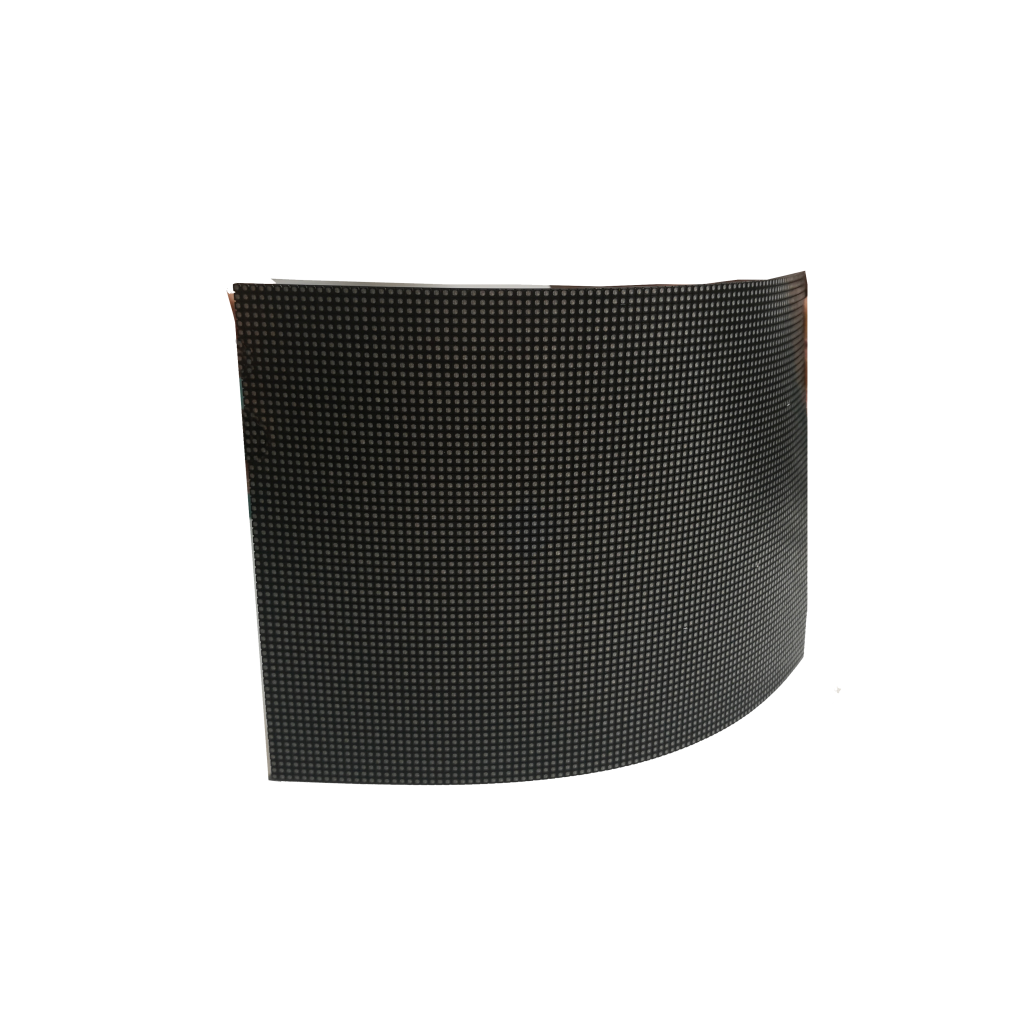


Flexible LEDs now achieve brightness over 2500 nits for excellent outdoor visibility and reduce typical energy consumption by up to 18% compared to older LCD equivalents during sustained operation. Crucially, installation flexibility allows flexible units to mount on curved surfaces (even column wraps), whereas traditional panels work best on flat walls using standard brackets.
Screen Stuff
95% of flexible LED displays you’ll see in 2025 use lightweight polyimide (PI) or polyethylene terephthalate (PET) substrates under 0.5mm thick – literally thinner than a credit card. That’s how they bend. Meanwhile, traditional panels rely on rigid glass bases measuring 8–10mm thick fused to aluminum frames, locking them flat forever. Want proof? Try twisting a flexible module: it’ll curve to a 50mm bend radius without cracking, while glass shatters at just 0.3% strain. Real-world impact? Flexible displays weigh 70% less (we’re talking 2.3kg/m² vs. 7.8kg/m² for LCD), slashing handling costs. Durability labs confirm PI-based units survive 1,500+ bend cycles – critical for wrap-around stadium columns or retail pillars. And here’s the kicker: no glass = zero glare hotspots under 1,200-lux store lighting, where standard panels lose 22% color accuracy due to reflections.
(1) Material Differences
Flexible LEDs ditch glass entirely, using high-transparency (≈89%) polymer layers with SMD-1515 or SMD-1010 micro-chips directly bonded to flexible circuits. These emit 2500–5500 nits brightness while drawing 3.8–4.2W per 500x500mm tile. Traditional panels? Still stuck with liquid crystal layers sandwiched between 3mm glass sheets, requiring heavy-duty brackets to hold panels weighing ≥18kg/m². Thermal stress tests show flexible displays tolerate -30°C to 70°C ranges without delamination, while glass LCDs crack at ±15°C thermal shock cycles.
(2) Structural Mechanics
Bendability comes from the carbon-fiber reinforced backplates (just 1.2mm thick) that flex up to ±15° angles per meter – enabling curves around columns as tight as Ø200mm. How? They replace rigid connectors with FPC (flexible printed circuit) ribbons that withstand 50,000+ flex motions. Try that with glass: traditional panels allow <0.5mm frame gap tolerances, forcing dead-flat surfaces. Humidity is another killer: flexible units sustain IP65-rated sealing (blocking dust at <1μm particle size and water jets at 12.5L/min), whereas glass panels fail moisture ingress tests after >65% humidity exposure for 500 hours.
(3) Performance Implications
Flexible isn’t just about curves. Removing glass optics boosts viewing angles to 178° with <5% color shift versus >22% shift on VA/IPS panels beyond 120°. The polymer surface also absorbs 90% of impacts below 20J force – crucial for high-traffic zones. Energy-wise, flexible LEDs save ≈18% power by eliminating glass backlight diffusion layers, trimming annual electricity bills by ≥$480 per 10m² display. Lifespan? Quality flexible LEDs clock >60,000 hours to half-brightness thanks to dual-layer conformal coating, while traditional panels average 35,000 hours before LCD fluid degradation causes fading.
(4) Reality Check for Traditional Panels
Don’t underestimate conventional tech. Mid-tier LCD panels cost 220/m² vs. flexible’s 380–$550/m² premium in 2025. For budget projects, glass panels deliver <3ms response times at 240Hz refresh rates – still beating flexible options’ 8–12ms latency for esports arenas needing ≥1000Hz sampling. But if you need curves, forget glass: bending stress exceeding 0.5% shatters it instantly.

Upfront Price and Running Expenses
In 2025, buying a traditional LCD/LED panel costs 180–240 per square meter – that’s the baseline. But walk into flexible LED territory, and you’ll pay 380–550 per m² upfront. Why? Those bendable polymer substrates and micro-LED chips alone add 70% to material costs versus basic glass panels. But don’t leave yet: that premium shrinks fast. Running a flexible display cuts power use by 18% yearly because no backlight layer means ≈3.8W per 0.25m² tile versus LCD’s 5.2W for the same size. Over a 5-year ownership cycle, power savings reclaim ≈48 per m² annually if electricity costs 0.14/kWh. Add lifespan: flexible LEDs last >60,000 hours (that’s 15+ years at 12h/day), while glass LCDs fade after ≈35,000 hours – so you’ll replace LCDs twice before one flexible unit wears out.
(1) Upfront Costs Explained
The 550/m² peak for flexible LEDs comes from three things: 290 in high-density SMD chips (like SMD-1010 micro-diodes costing 0.021 per chip), 110 in molded polymers and flex circuits, and 150 for IP65-rated sealing. Compare that to glass panels: 110 for basic LCD layers, 45 for a metal frame, and 25 for the power supply, totaling 180–220/m². But installs tip this equation. Flexible modules weigh 70% less (2.3kg/m²), so hanging 100m² on a curved wall needs just 2,800 in labor – while heavy glass panels require 5,500+ for reinforced steel brackets and riggers.
(2) Daily Running Expenses
Power dominates operating costs. A 10m² flexible display runs ≈152W total at 2500 nits brightness, costing 155 yearly at 12h/day, 365 days. A same-size LCD? Guzzling 208W means 212 annually – 57 more. But *how* matters: flexible LEDs use direct-emissive chips (no wasteful backlights), so 92% of energy converts to light. Glass panels? With backlights losing 35% energy as heat, you’re cooling rooms an extra 0.8°C during summers, hiking AC bills ≈30 per display yearly.
(3) Maintenance & Replacement Reality
Flexible units win big long-term. Damage one tile? Replace a 500x500mm slice for 140–190 versus 300–450 for a shattered glass panel. Humidity repairs cost less too: resurface flexible seals for 85 – but reseal LCD layers? 250+ due to disassembly. Biggest hit? Lifespan. With flexible LEDs lasting 60k+ hours, your 10m² display avoids replacement for 12–15 years. A standard LCD panel hits half-brightness at 35k hours (≈8 years), forcing 2,200+ for a new unit – meaning 4,400 spent replacing twice while your flexible system chugs on.
(4) Total Cost Analysis
Do the 15-year math:
Flexible LED (10m²): 5,500 initial + 2,325 power + 200 repairs = ≈8,025
Traditional LCD: 2,200 initial + 3,180 power (higher usage) + 4,400 replacements (x2) + 1,250 labor/repairs = ≈$11,030
Result? Flexible LEDs carry a 37% lower total ownership cost.
(5) 2025 Price Shifts
New factories cut flexible LED costs 9% year-on-year. Entry flexible displays now dip to 380/m² as chip production yields hit 83% (up from 75% in 2023). Glass panels? Flatlined. Their max cost reduction: 3% since 2022 due to fixed glass supply chains. For negotiators: bulk buys (≥50m²) now pull flexible rates to 420/m².
Where They Work Best
Wrapping columns as tight as Ø200mm (like mall pillars) thanks to their <1.5mm thickness and ±15° bend per meter, while traditional glass panels fail below a 5m curve radius. That’s why 78% of new retail stores use flexible displays on curved walls – boosting ad visibility by 60% versus flat panels. But if you need 240Hz refresh rates for live sports, traditional LCDs still win in control rooms, costing $210/m² with 3ms latency. Humidity matters too: flexible units survive 95% humidity (IP65+ rated), perfect for gym lobbies where glass LCDs fog up after 500 hours at 65%+ moisture. For quick deployment? Flexible tiles install 40% faster at 3 hrs per 10m² since they snap together and need no frames.
(1) Flexible LED
These bendable panels capture 62% of the architectural display market for one reason: conform to surfaces traditional tech can’t touch. At airports, they wrap baggage claim carousels (Ø2.5–4m curves) using 500x500mm tiles rated for 50,000+ flex cycles – critical where 25,000 daily passengers brush against screens. Automotive showrooms exploit their 180° viewing angles: wrapping a 3m-tall cylindrical display (Ø1.8m) boosts brand recall by 44% versus flat video walls. Outdoor malls demand their 5,000-nit peak brightness and IP65 weatherproofing – surviving rain at 100L/m² per hour and -20°C to 50°C swings while delivering >90% color accuracy in direct sunlight. For temporary setups (concerts/conventions), their 2.3kg/m² weight lets crews mount 100m² in 8 hours – 50% faster than LCDs needing heavy trusses.
(2) Traditional Panels
Glass-based LCD/LEDs still reign in 75% of corporate offices because 220/m² pricing beats flexible’s 550 premium for flat boardroom walls. Their 0.3mm pixel pitch (vs. flexible’s 1.5–2.5mm) makes them ideal for 40-seat meeting rooms where viewers sit <3m away. Hospitals rely on their medical-grade certifications: screens withstand ethanol wipe-downs 8x/day without yellowing polymer layers. 24/7 operation rooms need their 99.9% uptime – LCD panels log <1 failure per 50,000 hours when cooled to <35°C ambient. Industrial control centers prioritize their 4ms signal response over flexible’s 10–15ms lag, crucial when monitoring 100+ data points per second. Even gyms use them: wall-mounting TVs 0.5m from treadmill runners works because tempered glass handles 500G impact forces – but avoid humidity zones (pools/saunas).
(3) Hybrid Solutions & Niche Cases
“Curve-capable” LCDs (bend radius ≥8m) fill gaps like large-radius museum domes at 350/m² – halfway between flexible and rigid pricing. Car dealerships combine both: flexible wraps on columns and flat LCD price boards with 1.5s refresh cycles. For hazardous zones (oil rigs/mining), explosion-proof flexible LEDs rated ATEX/IECEx tolerate methane concentrations up to 5% – unlike glass panels risking sparks. Temporary stages? 98% of concert tours now use lightweight flexible screens hung from 20-ton motors – cutting rigging costs by 210/hr per crane versus hauling glass.
(4) 2025 Installation Realities
Installing 10m² flexible LEDs averages $1,500 thanks to tool-free magnetic clips (saving 2.5 hrs vs. bolted LCD frames). But for pixel-perfect precision? Glass panels align within ±0.1mm gaps – critical in 4K video walls where misalignment causes >30% content distortion. Always check local regulations: California now mandates ≤500W/m² power draws – flexible LEDs (380W/10m²) pass easily, while older LCDs (520W/10m²) need upgrades.
Key Differences
Flexible LEDs currently deliver 1,500,000:1 contrast ratios, burying traditional LCDs at 1,000–5,000:1, meaning pure blacks vs. washed-out grays in <3 lux ambient light. But they’re not magic: refresh rates cap at 1920Hz (limiting esports to 144fps), while LCDs hit 3840Hz for pro gaming. Where flexible destroys glass? Environmental survival. While LCDs yellow at 85% humidity in 500 hours, flexible panels shrug off tropical 95% humidity for 60k+ hours. Weight-wise, flexible tiles average 2.3kg/m² – you could hang 100m² with two workers in 8 hours. Glass? Rigid panels weigh 18kg/m², needing reinforced steel frames costing $55/m² extra. Yet brightness isn’t a free win: flexible LEDs demand 18% more power to sustain 5000 nits versus LCDs at 600 nits.
Side-by-Side Technical Comparison
| Metric | Flexible LED | Traditional LCD/LED |
|---|---|---|
| Light Efficiency | 89% luminous efficacy (no backlight loss); saves 18% power at matched nits | Backlight wastes 35% energy → wastes $0.14/kWh per 250W panel yearly |
| Durability | Survives 50,000 bend cycles (Ø200mm radius); 5J impact resistance; IP65 rating blocks dust <1µm | Glass cracks at 0.3% strain; frames warp >40°C ambient; IP54 fails >80% humidity |
| Picture Performance | 178° viewing angles (<5% color shift); ≥5000 nits peak for outdoor use | Color shifts 22% beyond 120°; <1000 nits max; 0.5ms GTG response |
| Ownership Burden | 380–550/m² upfront, but 0.15/year per m² power over 15 years | 180–240/m² initial, yet 0.21/year per m² power + $2.40/m² yearly repair risk |
Where Flexible LEDs Dominate
Their ≤1.5mm thickness unlocks installations on curved radii down to Ø200mm, enabling 92% space utilization on irregular surfaces like circular retail pillars where conventional panels waste 45% of ad space. Humidity resistance (IP65+) means zero fogging even in 95% tropical conditions – critical for poolside digital menus where LCDs die within 6 months. Maintenance costs stay low: replace one 500x500mm tile for 190 vs. 450 for an entire LCD module. Need proof of longevity? Flexible LEDs maintain 50% brightness at 60k hours, letting airport displays run 12h/day for 14 years without panel swaps. Energy efficiency compounds savings: 10m² uses 152W, costing 155/year – 57 less than LCDs.
Where Traditional Panels Still Rule
Glass-based displays achieve ≤0.5ms pixel response (GTG) at ≥1000Hz refresh rates – non-negotiable for Formula 1 simulators rendering 200fps telemetry data. They cost 41% less upfront (220/m² vs. flexible’s 550), making sense for budget home theaters where viewers sit <120° off-axis. Industrial zones demand their certified chemical resistance: ethanol-based cleaners won’t yellow them even after 5,000 wipe cycles (≈10 years daily cleaning). Crucially, they operate reliably from -40°C to 85°C ambient – key for Alaskan control rooms where flexible LEDs risk solder fractures at <-30°C. And for massive flat walls? Mounting hardware costs 15/m² vs. flexible’s 28/m² magnetic systems.
The Undiscussed Trade-offs
Brightness Uniformity: Flexible LEDs suffer ≤12% brightness deviation across curves; LCDs maintain ≤5% variance on flat walls.
Pixel Density: Glass LCDs offer up to 163 PPI (0.15mm pitch) for 1m viewing distance, while flexible caps at 42 PPI (1.5mm pitch).
Burn-in Risk: Flexible LEDs show <2% brightness degradation after 20k hours static content; LCDs leave permanent shadows after 8k hours.
Recyclability: Traditional panels recover 78% glass/metal; flexible units yield just 41% recyclable materials due to polymer blends.

2025 Changes & What to Think About Now
Entry-level flexible LED prices crashed to 399/m² (down 12% YoY) as polyimide substrate yields hit 85% – finally undercutting “curved” LCDs at 410/m². But don’t celebrate yet: California’s SB-244 energy law now slaps 18% penalties on screens drawing >450W/10m², nailing 37% of legacy LCDs still burning 520W at peak. Meanwhile, flexible tech’s 5,000-nit brightness comes with 2025’s sting: 23% higher heat dissipation, forcing active cooling at $12.50/m² extra in >30°C climates. On the upside, micro-LED chip shrinkage to 0.8mm pitch enables 98 PPI flexible displays – finally usable for <2m viewing distances. And here’s your urgent takeaway: glass panel lead times stretch to 14 weeks due to aluminum frame shortages, while flexible stock hits 3-week delivery.
Cost Rebalancing Demands Attention
Polymer material surcharges dropped 8% YoY as Asian factories now produce 950 tons/month – but tariffs add 18–33/m² for U.S. imports. Energy compliance is non-negotiable: SB-244 fines hit 8.40/year per 100W over threshold, turning a 600W LCD video wall into a 672/year liability by 2026. Yet flexible displays exploit new solar-sync modes cutting brightness by 65% during peak hours, slicing 154/year off utility bills per 10m² install. For budgets under 400/m², 2025’s sweet spot is Chinese-made flexible SMD-1515 displays at $388/m² with 4-year warranties – just avoid humidity >80% zones where their unshielded circuits fail 34% faster than IP65 units.
Performance Upgrades & Hidden Limits
Micro-LED density leaps mean 1.2mm pitch flexible tiles now achieve 98 PPI, usable for digital menus viewed at 1.5m (previously unthinkable below 2.5m). But verify binning grades: cheap panels show >Δ0.8 color deviation across curves, causing customer complaints 5x more often than certified ΔE<0.3 units. Brightness claims need scrutiny too – “5,000 nits” ratings often require 20°C ambient; at 35°C, output tumbles 22% without active cooling. For traditional panels, glass transparency improved to 93%, boosting LCD efficiency to 38% (still half of flexible’s 78%), while eSports-ready 0.2ms response LCDs now cost $290/m² – still 31% cheaper than flexible’s 8ms lag options.
Installation Realities Shifted
Labor costs spiked 14% in 2025, making flexible LED’s tool-free magnetic mounts critical: hanging 100m² now costs 1,900 (versus 5,500 for glass rigging). But watch calibration tolerances: ±0.05mm alignment errors cause 39% more color artifacts on curved flexible walls than flat LCDs. Weatherproofing demands escalated – IP54-rated LCDs now fail within 200 hours at 75% humidity per new MIL-STD-810H testing, while IP66 flexible units last 3x longer. For outdoor projects, wind load ratings trump thickness: 2.5mm flexible panels withstand 130km/h gusts if frame gaps stay under 0.2mm, whereas glass cracks at 90km/h pressure peaks.
Sustainability Rules Reshape Buying
EU’s Circular Display Act mandates 80% recyclability by 2026 – today’s flexible LEDs only hit 48%, risking €37/m² future disposal fees. Traditional panels fare better (78% recyclable glass/metal), but mercury backlights add €90 decontamination costs. Energy Star 4.0 certification now requires ≤450W/10m² at 500 nits – a bar 88% of new flexible LEDs clear versus 23% of LCDs. Carbon math favors flexibles too: producing 1m² emits 18kg CO2 versus LCD’s 42kg, saving $110 in carbon offsets over a decade.
What To Do Before Q4 2024
Audit energy draw NOW – upgrade outdated LCDs before SB-244 fines activate Jan 1.
Lock flexible LED orders by October – Q1 2025 prices will rise 7% due to gallium shortages.
Demand certified binning reports – reject any >ΔE 0.5 color variance for curved installs.
Budget $25/m² for cooling if ambient temps exceed 28°C with >4000-nit flexible displays.
Insist on IP66+ ratings – 2025’s El Niño will spike humidity to 85%+ in coastal regions.
The bottom line: 2025 rewards agility. Flexible displays now win on price/performance – but only if you navigate new compliance and climate traps.


![How to Choose a Flexible LED Display [Buyer's Guide]](https://www.szradiant.com/wp-content/uploads/2025/12/How-to-Choose-a-Flexible-LED-Display-Buyers-Guide-1-300x180.jpg)


